Accessibility version
Font size: 14 PX
Site colors:

Artificial Intelligence Directorate

The Artificial Intelligence Directorate of the Information and Analytical Center for Environmental Protection develops and implements digital tools for processing and analysing environmental information. The Directorate focuses on automating analytical processes, identifying environmental risks, violations and data anomalies, and producing clear information to support management decision-making. The Directorate’s key project is the implementation of AI Analyst/EcoAgent.

AI Analyst/EcoAgent

EcoAgent is a digital platform for comprehensive analysis of environmental data. The system consolidates information from production environmental control reports, automated monitoring systems, inspections, violations, compliance orders and fines. The platform enables the comparison of indicators from different sources, identification of regulatory exceedances, anomalies and inconsistencies, assessment of enterprise risks, and preparation of analytical materials in a clear visual format.
Map Section

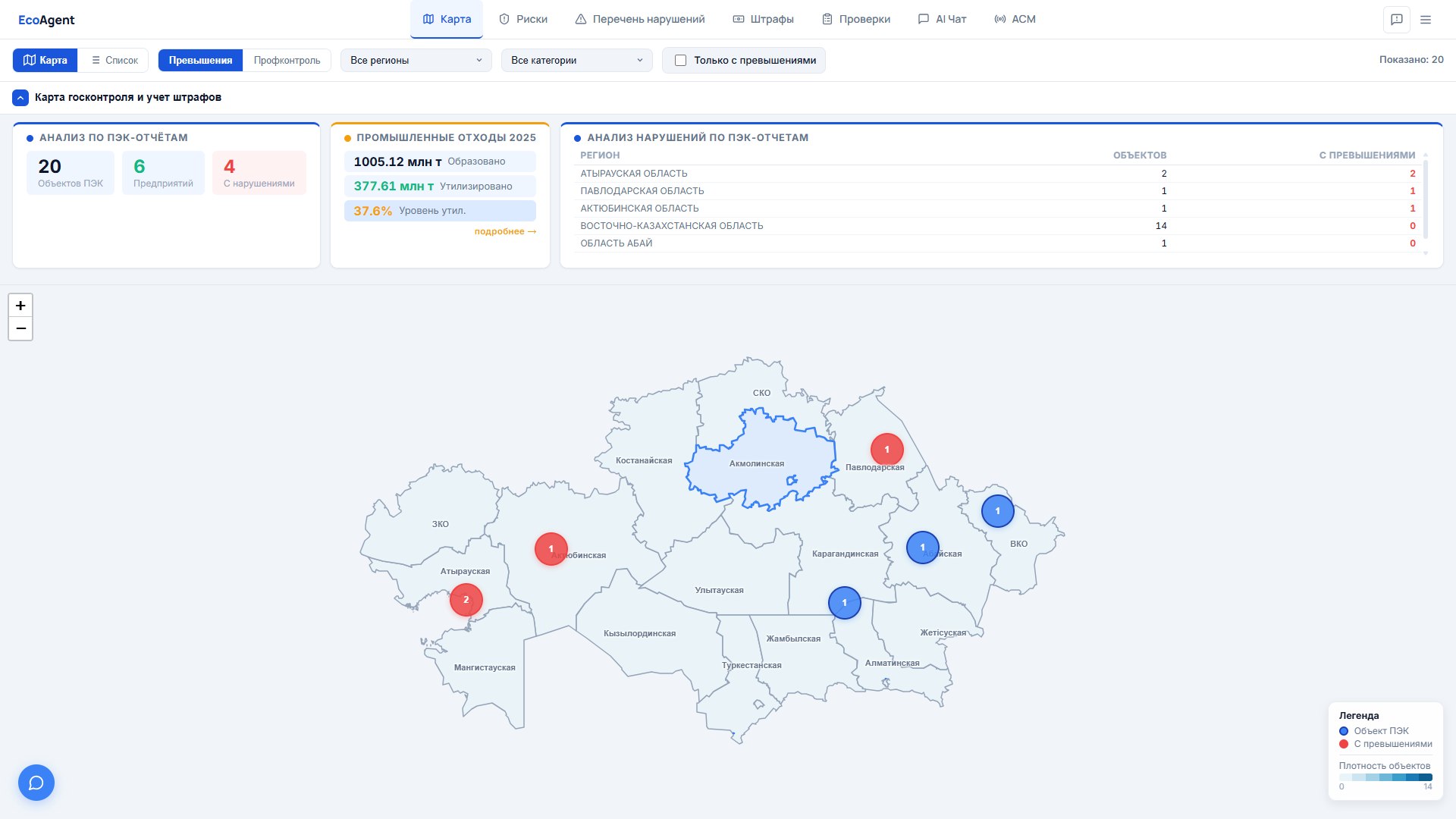
The EcoAgent platform Map section interface

The Map section provides a clear visual representation of environmental information by region of the Republic of Kazakhstan. The map displays production environmental control facilities, enterprises with identified exceedances, and regional indicators. The upper part of the section presents consolidated data on the number of facilities and enterprises, identified violations, and the generation and disposal of industrial waste. Users can select a region and data category, display only facilities with exceedances, and access detailed information on individual indicators.

Enterprise Environmental Passport and PEC Analytics

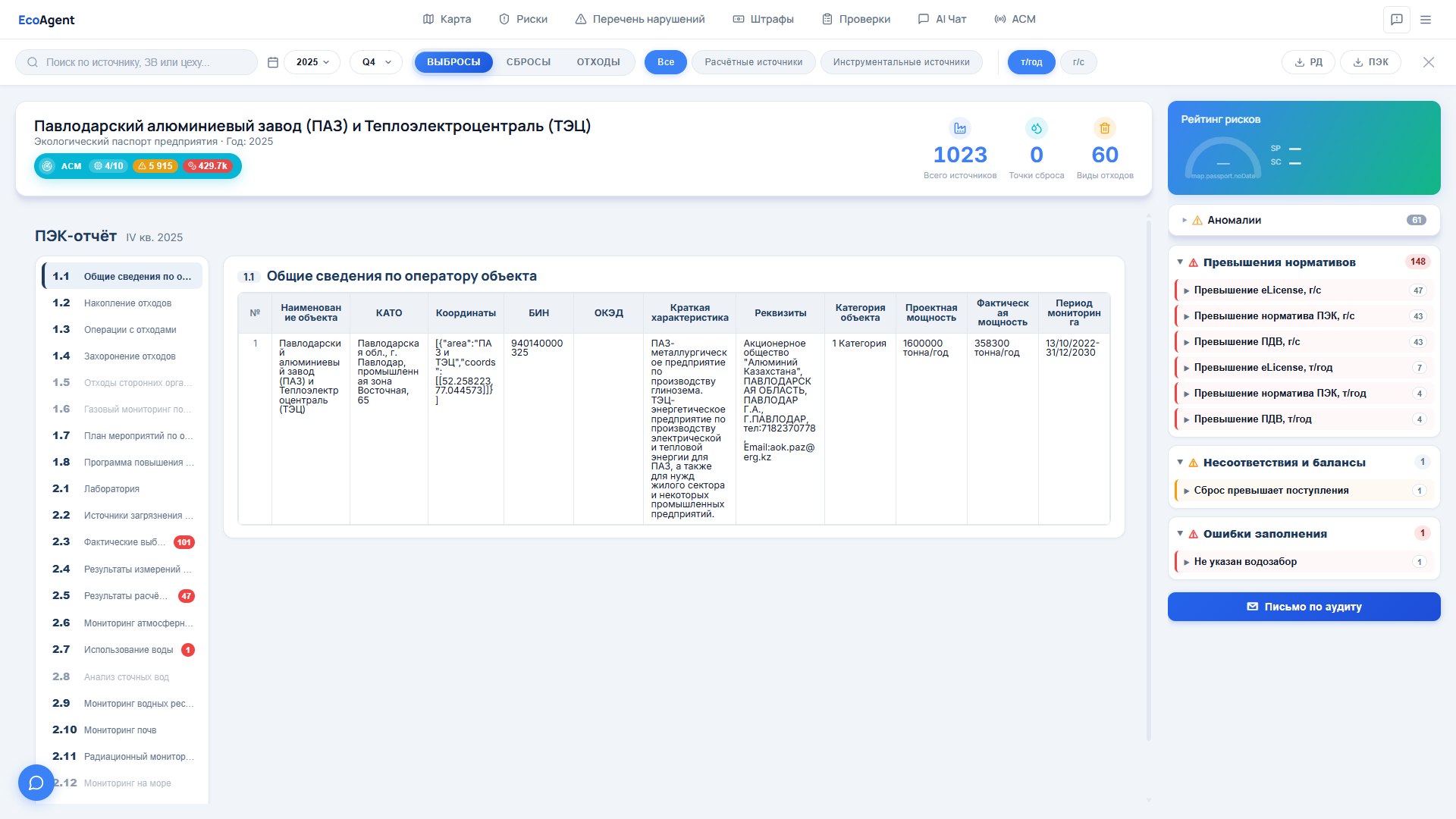
Environmental passport and production environmental control analytics

The environmental passport creates a unified enterprise profile based on the available environmental information. The profile contains information on the facility operator, emission sources, discharge points, waste generation and management, water use, measurement results, and other production environmental control indicators. PEC reports are presented in a structured format under the relevant sections. The system automatically identifies regulatory exceedances, anomalies, inconsistencies, balance discrepancies, and reporting errors. For each identified case, the relevant report section and the number of detected deviations are indicated. An audit letter may be generated on the basis of the analysis results. Environmental permitting documentation and PEC reports are also available for download.

Risks Section

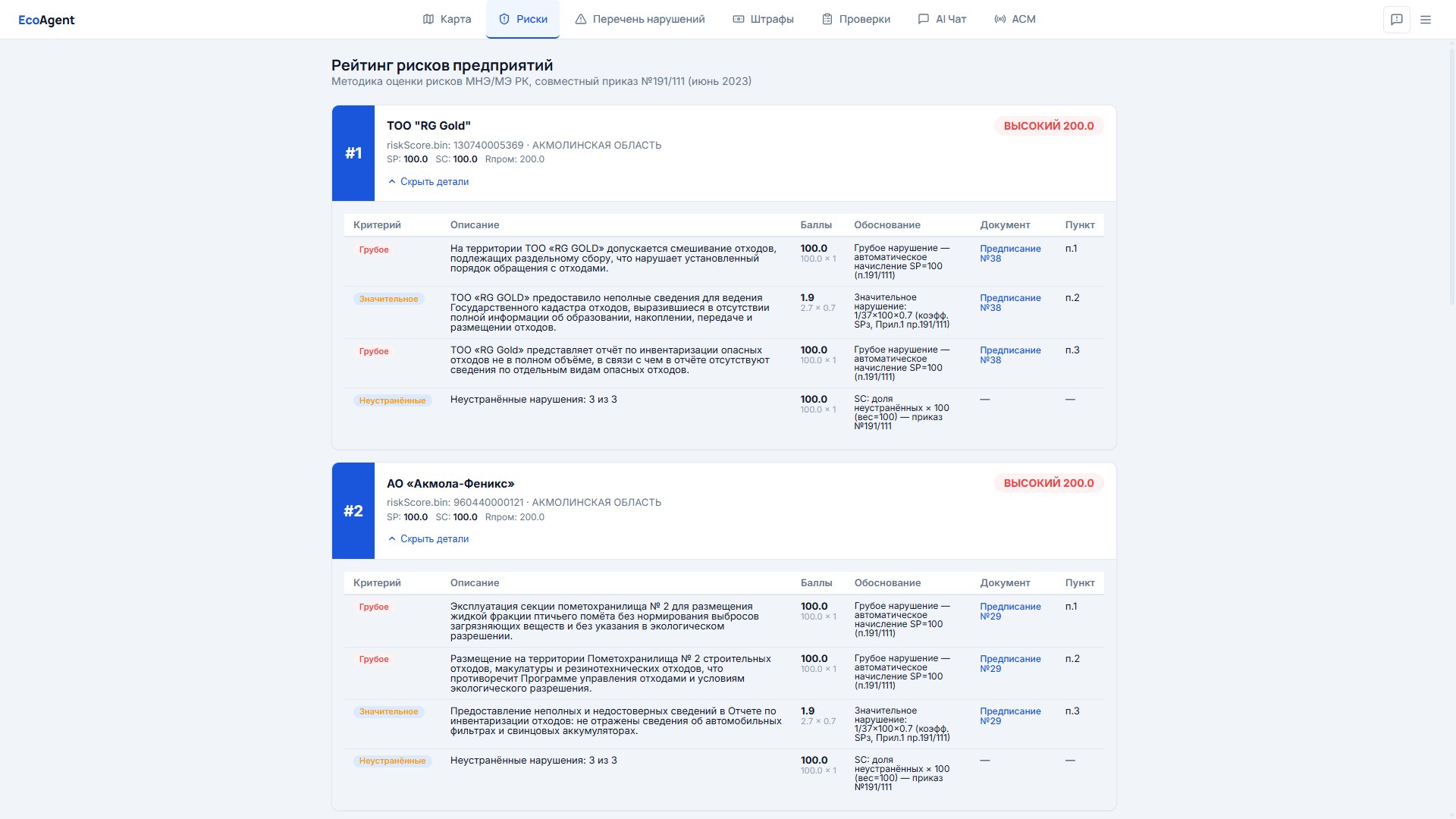
Ranking of enterprises by environmental risk level

The Risks section is intended to rank enterprises by environmental risk level. For each enterprise, it displays the final risk score, the criteria applied, a description of identified violations, points assigned, and the basis for the calculation. It also specifies the documents and relevant provisions on which the assessment is based. The section enables users to identify enterprises with the highest risk levels and examine in detail the factors that influenced the final ranking.

List of Violations Section

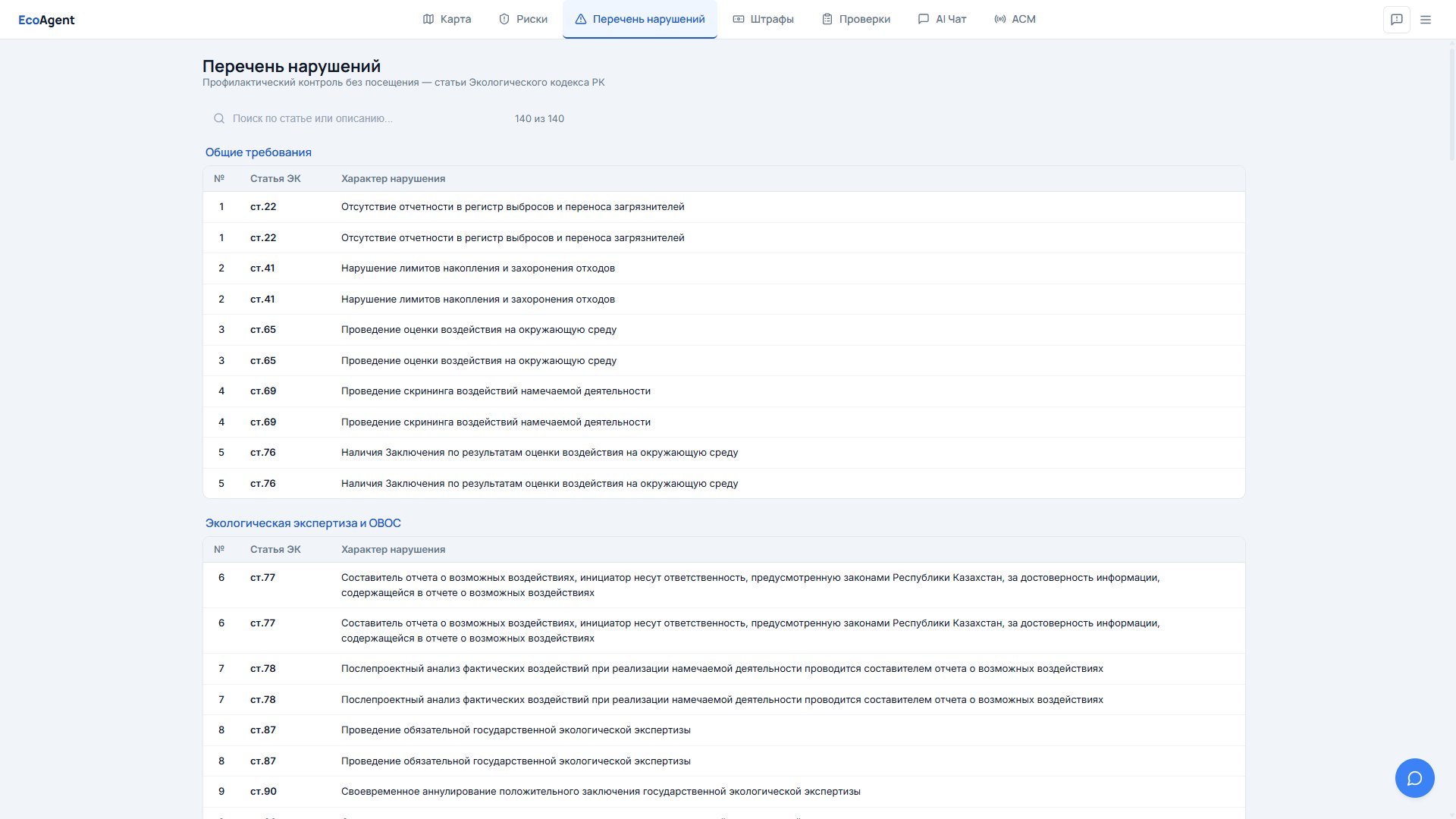
List of violations of environmental legislation

The section contains a structured list of potential violations of the environmental legislation of the Republic of Kazakhstan. The information is grouped by area and includes a reference to the relevant article of the Environmental Code together with a description of the nature of the violation. A search by article number or violation text is available for quick retrieval. The section serves as a reference tool for analytics and preventive control conducted without an on-site visit to the enterprise.

Fines Section

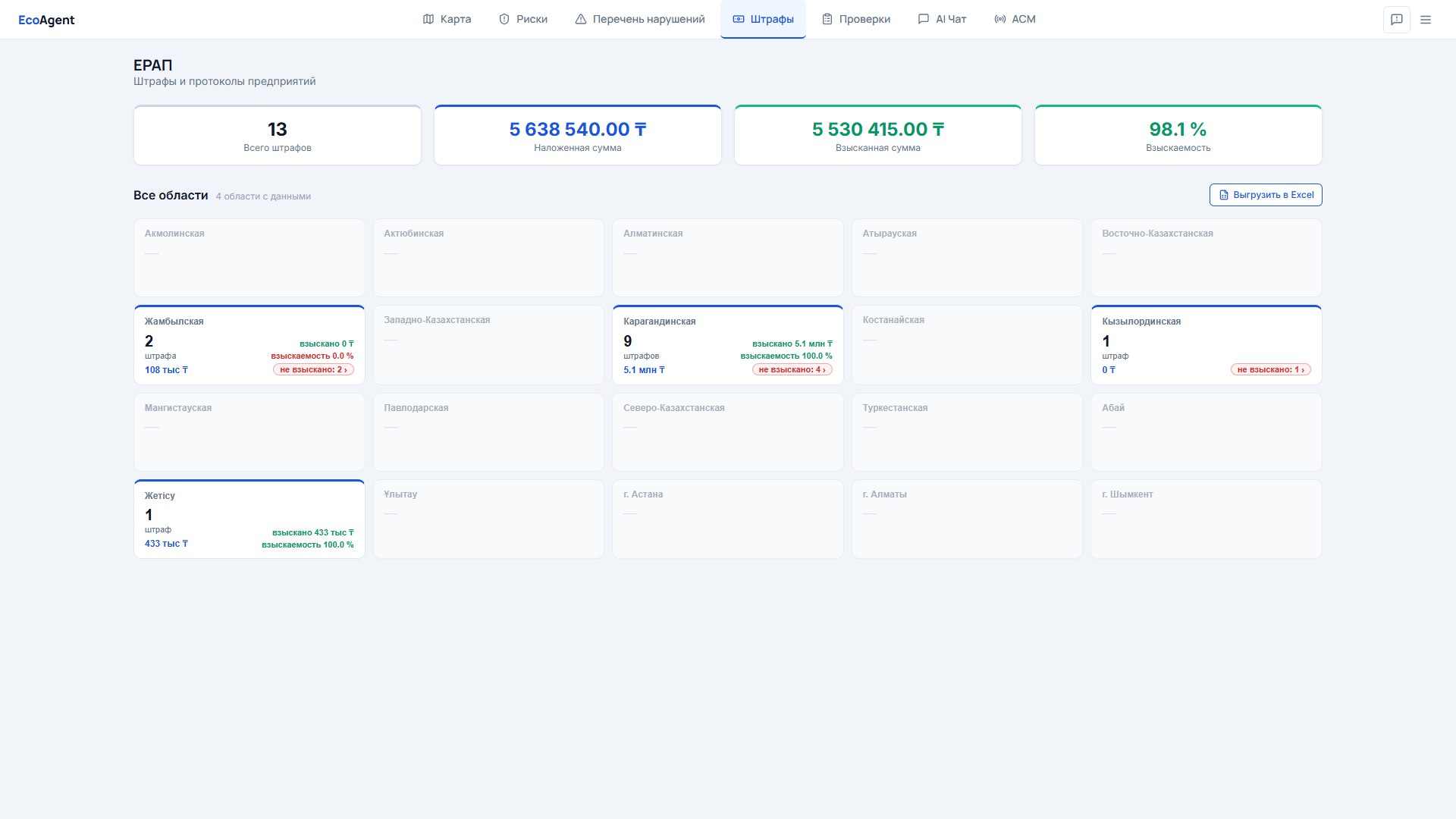
Consolidated information on enterprise fines and administrative records

The Fines section displays regional information on fines and administrative records concerning enterprises. The system presents the total number of fines, the amounts imposed and collected, and the collection rate. Regional cards show the number of fines, amounts assessed, and collection information. Data can be exported to Excel for further processing and reporting.

Inspections Section

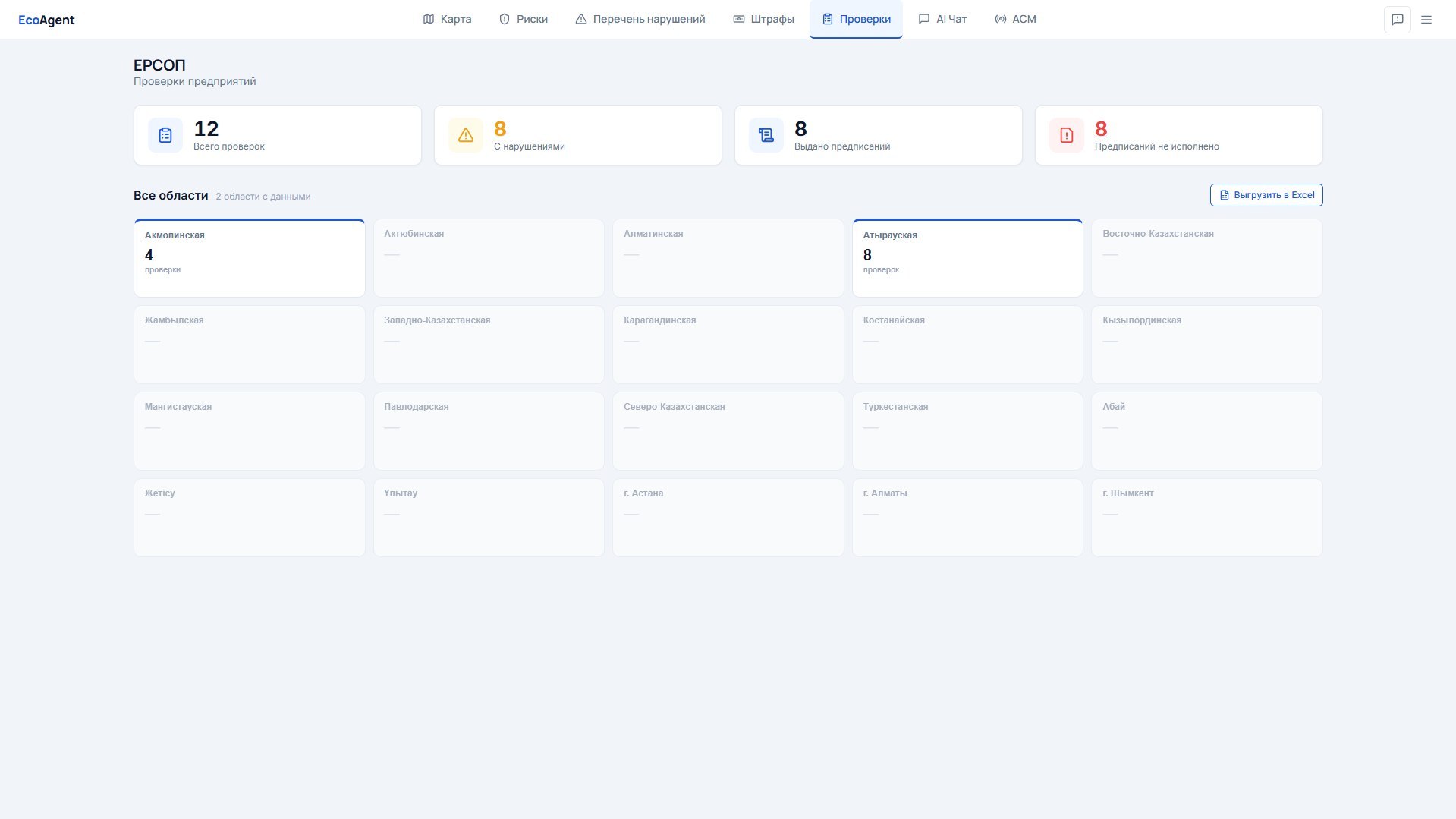
Information on inspections, violations and compliance orders

The Inspections section contains information on inspections of enterprises, identified violations, and compliance orders issued. The summary displays the total number of inspections, the number of inspections that identified violations, the number of compliance orders issued, and the number of outstanding orders. Data are presented by region, enabling users to quickly identify the regions for which relevant information is available. Results can also be exported to Excel.

AI Chat Section

Intelligent chat for environmental data analysis

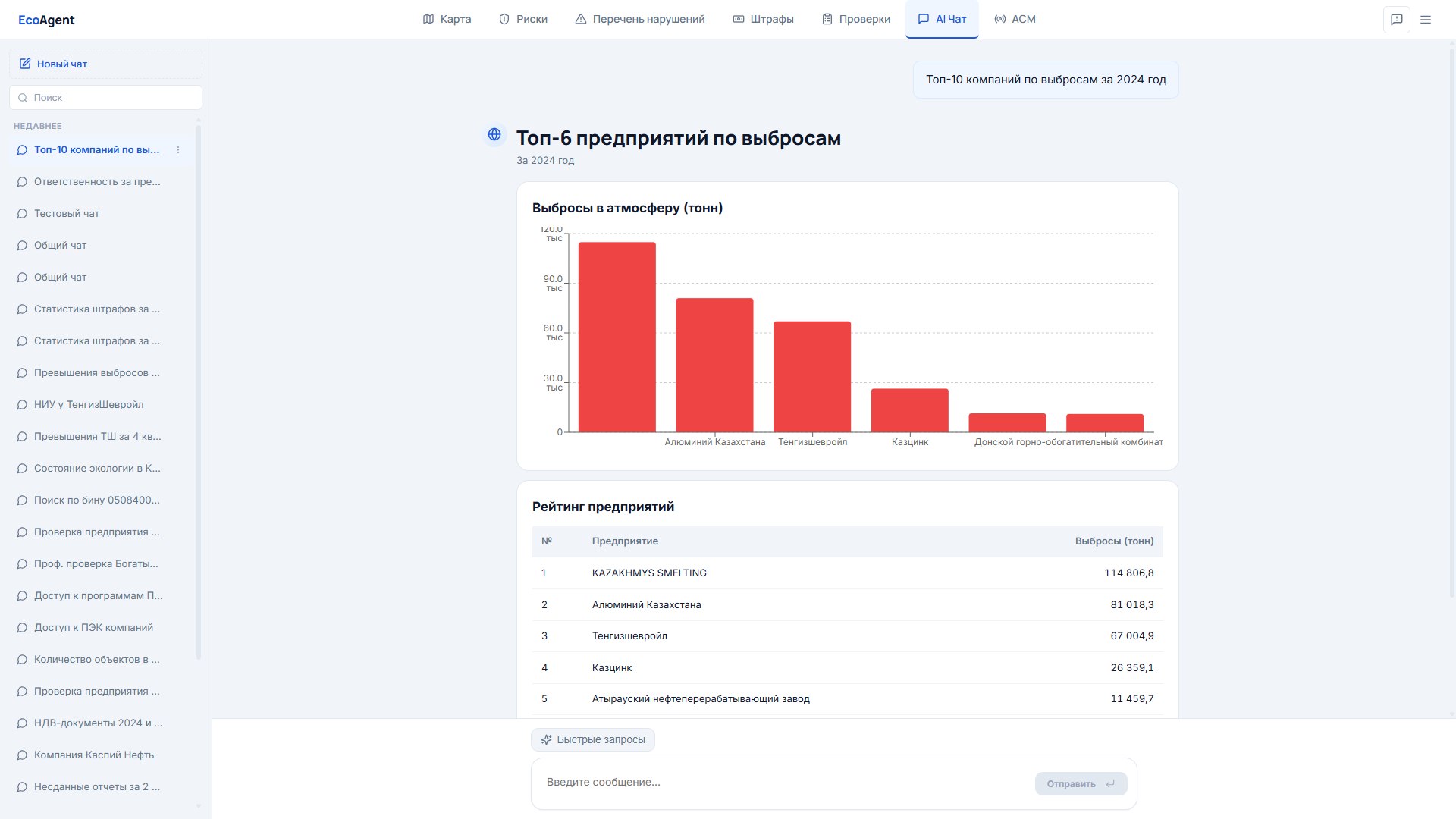
AI Chat is an intelligent tool for working with environmental data through natural-language queries. A user may formulate a question, for example by requesting a ranking of enterprises by emission volume for a specified period. In response, the system produces analytical information as text, a table, or a chart. The tool simplifies information retrieval, preparation of consolidated data, and visualisation of analysis results without requiring users to process large datasets independently.

AMS Section

Analytics for automated monitoring system data

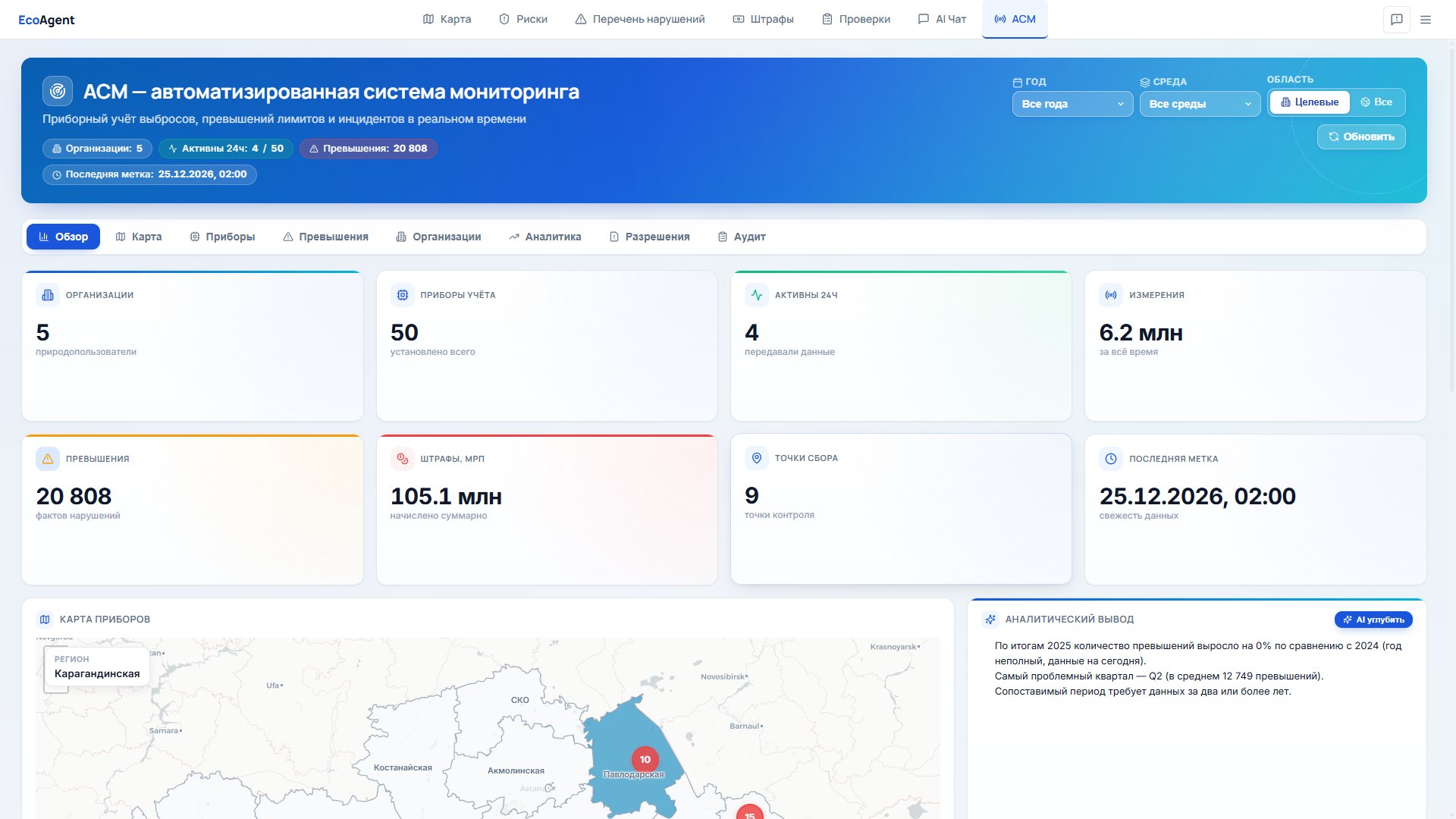
The section is intended for analysing data from automated monitoring systems. It displays information on organisations, metering devices, active data transmission sources, the number of measurements, identified exceedances, and data collection points. The date and time of the latest data received are also shown. Users can filter information by year, environmental component, and region. The map displays the territories and facilities from which data are received, while a dedicated analytics block generates findings on exceedance trends, problematic sources, and the completeness of the information submitted. Additional subsections support analysis of metering devices, organisations, permits, exceedances, and AMS data audit results.

🌿 AI-ассистент